Disclaimer & Copyright Notices; Optimized for the MS Internet Explorer
Contractual participants
Soil & Water Conservation Society of Metro Halifax (SWCSMH)
Volunteer Supervisor: Shalom M. Mandaville (Professional Lake Manage.)
Selections from our photo gallery
July 26, 2006 
Contents
(See also a listing of most of our formal studies, both volunteer as well as contractual, and the lake stakeholders)
Since some of our projects
involve full day-time commitment during weekdays, a significant part of
the work has been carried out by contractural participants. These
studies were conducted by qualified professionals acting under our
sponsorship, supervision and/or assistance. Though not all the projects
below were conducted by contracted staff. In brief, the work completed
in these phases are as follows:
![[Img]](VIEW/ICON/educ.gif) Project A
was completed during March-Sept.1992 by Julie Sircom, an Honours
Biology graduate (and on the Deans list) of Acadia University. She had
worked a year at the Simon Fraser University, B.C. before coming to us.
This project was mostly funded by the Federal Government. Collaborators were the Engineering Dept. (John Sheppard PEng) of the Halifax County Municipality, and the Dalhousie Univ. Biology Dept. (Prof. Martin Willison PhD).
Project A
was completed during March-Sept.1992 by Julie Sircom, an Honours
Biology graduate (and on the Deans list) of Acadia University. She had
worked a year at the Simon Fraser University, B.C. before coming to us.
This project was mostly funded by the Federal Government. Collaborators were the Engineering Dept. (John Sheppard PEng) of the Halifax County Municipality, and the Dalhousie Univ. Biology Dept. (Prof. Martin Willison PhD).
![[Img-star-brown]](VIEW/ICON/star-brown.gif) Volunteer stakeholders who assisted directly were LCdr. Tom Willdey of Halifax, Walter Pilon of Sheldrake, Dr. Mike Moss MD of Fish Lake, Doug McLaren PEng of Windsor Junction, Steve Rigden PEng of Settle Lake, and Shalom Mandaville (Professional Lake Manage.) of Dartmouth.
Volunteer stakeholders who assisted directly were LCdr. Tom Willdey of Halifax, Walter Pilon of Sheldrake, Dr. Mike Moss MD of Fish Lake, Doug McLaren PEng of Windsor Junction, Steve Rigden PEng of Settle Lake, and Shalom Mandaville (Professional Lake Manage.) of Dartmouth.
![[Img]](VIEW/ICON/projects.gif) Project B
was mostly carried out during April-Nov.1993, and employed four
professionals at different times. This project was also funded mostly
by the Federal Government
with the support of Ms. Mary Clancy, MP for Halifax, Hon. Michael
Forrestall, Senator- Dartmouth. Collaborators/Partners in this project
were the Agricultural Eng. Dept. (through the total co-operation of one of our members, Prof. Jack Burney PhD, PEng), TUNS; the National Centre for Enteroviruses (through the leadership of one of our members, Prof. Spencer H.S. Lee PhD), V.G. Hospital; Dept. of Microbiology & Immunology (Spencer Lee), Dalhousie University; Biology Dept. (Prof. Martin Willison, PhD), Dalhousie University; and the Engineering Dept. (John Sheppard PEng) of Halifax County Municipality.
Project B
was mostly carried out during April-Nov.1993, and employed four
professionals at different times. This project was also funded mostly
by the Federal Government
with the support of Ms. Mary Clancy, MP for Halifax, Hon. Michael
Forrestall, Senator- Dartmouth. Collaborators/Partners in this project
were the Agricultural Eng. Dept. (through the total co-operation of one of our members, Prof. Jack Burney PhD, PEng), TUNS; the National Centre for Enteroviruses (through the leadership of one of our members, Prof. Spencer H.S. Lee PhD), V.G. Hospital; Dept. of Microbiology & Immunology (Spencer Lee), Dalhousie University; Biology Dept. (Prof. Martin Willison, PhD), Dalhousie University; and the Engineering Dept. (John Sheppard PEng) of Halifax County Municipality.
Volunteer stakeholders who assisted directly were LCdr. Tom Willdey of Halifax, Ron Sampson of Chezzetcook, Kenneth Brown of Porter's Lake, Troy Comeau of Lake Echo, CWO Bob MacDonald of Springfield Lake, Steve Rigden PEng of Settle Lake, Doug Frizzle of Stillwater Lake, Trish Hattie BEd of Lake Fletcher, Graham Sullivan of Beaverbank, S.J. Thomas BEd, of Loon Lake, Doug Ralston BEd of Third Lake, Cliff Tyner PEng of Dartmouth, Prof. Jack Burney PhD PEng of TUNS, Prof. Spencer Lee PhD of Dalhousie Microbiology Dept., Andrew Hebda of Dalhousie University, Lynn Maillet of Dalhousie Biology Dept, Ken Doe at Environment Canada, BIO, and Shalom Mandaville (Professional Lake Manage.) of Dartmouth.
The four professionals were as follows:
- {Project B-1}- Tom Campbell, an Agricultural Engineering
graduate of TUNS with an year's experience. While at TUNS, Tom had a
distinguished record and was recipient of both of the highest awards
given for scholarly achievement. Tom's project yielded some base data
with respect to watershed uses, and has been beneficial to us for our
computer modelling of the theoretical phosphorus loading.
- {Project B-2}- Dave Wismath PEng, a graduate of Queens University, Ontario and a Professional Geotechnical Engineer with close to 8 years experience at the time. He completed the report, [Project B-2].
- Harry Knee, a graduate in Biochemistry from the Memorial
University of Newfoundland. His project was to identify the
phytoplankton species of several lakes, analyse the Ch-a content and
develop kite diagrams. For various reasons, this project yielded
nothing of value.
- {Project B-3}- Lisa McClafferty, a 1991 graduate in Biology
from the Dalhousie University. Her project was of a short duration (few
weeks) since she was replacing Harry Knee. Her work was very good and
she carried out phytoplankton species identification in various lakes.
She thoroughly utilized the lab facilities provided by Prof. Spencer Lee PhD,
the Co-Director of the National Centre for Enteroviruses. Lisa also
utilized the facilities of the Dalhousie Biology Dept. for preparation
of electron micrographs.
Her report was [Project B-3].
![[Img]](VIEW/ICON/star.gif) Project C commenced during April 1993 by Dave Wismath PEng, and was completed in 1998 by Joanne Vokey BSc(Hons).
Under this project, Dave Wismath, an experienced professional
geotechnical engineer was employed during April to October 1993 with a
grant from the Federal Government.
Dave continued the field monitoring during the spring of 1994 as a
volunteer. Joanne Vokey, a keen graduate of the Biology Dept., Memorial University
of Newfoundland already had published or co-published research papers
in scientific journals, one of which was published by the Royal Society
of London, a very admirable trait indeed. The first 50 phosphorus
samples were analyzed by Bill Horne, Inorganic Chemist, EP labs, BIO of
Environment Canada, and the rest of samples (ca. 200) were analyzed under a grant from the Nova Scotia Dept. of Environment. The project was stationed during 1993 at the Agricultural Eng. Dept. (through the total co-operation of one of our members, Prof. Jack Burney PhD, PEng), TUNS, and during 1998 at the National Research Council of Canada Institute for Marine Biosciences (through the supreme co-operation of it's Director, John van der Meer PhD, and it's senior Research Officer, Stewart Johnson PhD), Halifax.
Project C commenced during April 1993 by Dave Wismath PEng, and was completed in 1998 by Joanne Vokey BSc(Hons).
Under this project, Dave Wismath, an experienced professional
geotechnical engineer was employed during April to October 1993 with a
grant from the Federal Government.
Dave continued the field monitoring during the spring of 1994 as a
volunteer. Joanne Vokey, a keen graduate of the Biology Dept., Memorial University
of Newfoundland already had published or co-published research papers
in scientific journals, one of which was published by the Royal Society
of London, a very admirable trait indeed. The first 50 phosphorus
samples were analyzed by Bill Horne, Inorganic Chemist, EP labs, BIO of
Environment Canada, and the rest of samples (ca. 200) were analyzed under a grant from the Nova Scotia Dept. of Environment. The project was stationed during 1993 at the Agricultural Eng. Dept. (through the total co-operation of one of our members, Prof. Jack Burney PhD, PEng), TUNS, and during 1998 at the National Research Council of Canada Institute for Marine Biosciences (through the supreme co-operation of it's Director, John van der Meer PhD, and it's senior Research Officer, Stewart Johnson PhD), Halifax.
Volunteer stakeholders who assisted directly were Bill Horne at Environment Canada, BIO, Prof. Jack Burney PhD PEng of DalTech, and Shalom Mandaville (Professional Lake Manage.) of Dartmouth.
![[Img]](VIEW/ICON/readers.gif) Project D
was essentially carried out during the period, July 1997 to March 1998,
and employed six professionals at different times. This project was
funded mostly by the Federal Government through the HRC, Halifax. Collaborators/Partners in this project were the National Centre for Enteroviruses (through the leadership of one of our members, Prof. Spencer H.S. Lee PhD), QEII Health Sciences Centre, Halifax; National Research Council of Canada Institute for Marine Biosciences (through the co-operation of it's Director, John van der Meer PhD., and it's senior Research Officer, Stewart Johnson PhD), Halifax; Biological Engineering Department (through the support of one of our members, Prof. Jack Burney PhD, PEng), DalTech; and to a lesser extent, the Priority and Policy Group (Tony Blouin PhD, Manager, Environmental Policy), Halifax Regional Municipality (HRM).
Project D
was essentially carried out during the period, July 1997 to March 1998,
and employed six professionals at different times. This project was
funded mostly by the Federal Government through the HRC, Halifax. Collaborators/Partners in this project were the National Centre for Enteroviruses (through the leadership of one of our members, Prof. Spencer H.S. Lee PhD), QEII Health Sciences Centre, Halifax; National Research Council of Canada Institute for Marine Biosciences (through the co-operation of it's Director, John van der Meer PhD., and it's senior Research Officer, Stewart Johnson PhD), Halifax; Biological Engineering Department (through the support of one of our members, Prof. Jack Burney PhD, PEng), DalTech; and to a lesser extent, the Priority and Policy Group (Tony Blouin PhD, Manager, Environmental Policy), Halifax Regional Municipality (HRM).
Volunteer stakeholders who assisted directly were LCdr. Tom Willdey of Halifax, Ron Sampson of Chezzetcook, Rodney Frail of Dartmouth, CWO Bob MacDonald of Springfield Lake, Don Rix PEng of Lake Major, Walter Pilon of Sheldrake, Darrell MacInnis of East Hants, Mark Leaman of Tantallon, Prof. Jack Burney PhD PEng of TUNS, Prof. Spencer Lee PhD of Dalhousie Microbiology Dept., Steve Fry of Dalhousie Biology Dept, Ken Doe
at Environment Canada, BIO, Prof. J.S.S. Lakshminarayana PhD FLS of the
Univ. of Moncton, NB, Prof. Jack McLachlan PhD of Dalhousie Biology
Dept., Prof. John Grant PhD of Dalhousie Oceanography Dept., Nelson
Watson PhD of Dartmouth, MCPL Dan DesLauriers of CFB Shearwater, and Shalom Mandaville (Professional Lake Manage.) of Dartmouth.
The projects accrued were as follows:
- {Project D-1}- Pam Bishop, a 1995 biology graduate from Mount Allison University,
New Brunswick. She had graduated with distinction and was also a
recipient of the Canada Scholars Award (1992). She prepared the report,
[Project D-1].
Select snapshots of the work of Pam Bishop:
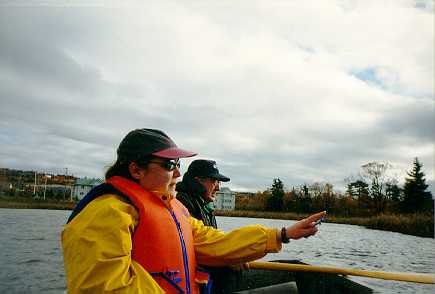
- Pam
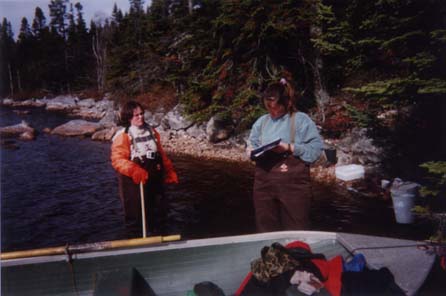
collecting water samples with a Kemmerer sampler at the deep station of
Lake Charlotte on August 20, 1997. Looking on was Rodney Frail, a
friend of the owner of the large boat, (one of our partners), Ron
Sampson of Gaetzbrook.
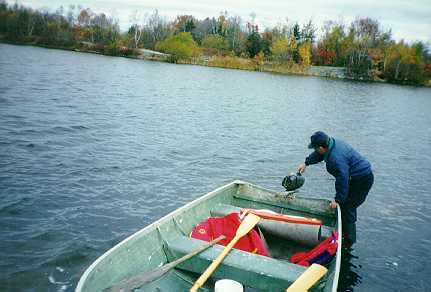
- Volunteer, Ron Sampson
assisting Pam Bishop at Lake Charlotte. Also present in the boat were
biologist, Pam Bishop, Rodney Frail and Professional Lake Manage.,
Shalom Mandaville.
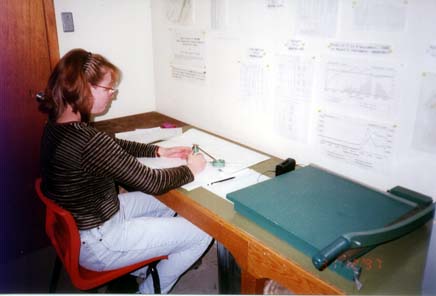
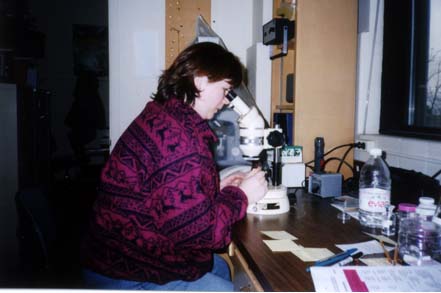
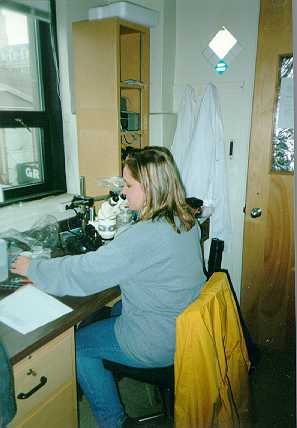
- Pam diligently identifying the phytoplankton through an inverted microscope at the Lab of one of our major partners, the National Centre for Enteroviruses, QEII Health Sciences Centre.
- Pam studiously working with a planimeter
loaned to us by Prof. Dr. Jack Burney PhD, PEng at the Lab of another
of our major partners, the Biological Engineering Dept., DalTech.
- {Project D-2}- Kim Hynes, an ecologist and a 1997 Ecology and Environmental Studies
graduate from the University of Toronto at Scarborough, Ontario. Kim
had studied Aquatic Entomology under a world-class expert, Prof. D. Dudley Williams PhD, DSc.
Kim was primarily responsible for the successful completion of this
project. Two biologists assisted her at different times, and the first
during Aug.-Sept. 1997 was Tara Travers, a 1995 Marine Biology graduate
from Dalhousie University, Halifax, and the second during Oct.-Dec. 1997 was Catherine Reeves, a 1995 biology graduate from University of Guelph, Ontario. Kim Hynes prepared the report, [Project D-2].
Select snapshots of the fieldwork in the collection of benthic macroinvertebrates:
- Mark Leaman, one of our key volunteers who helped biologists Kim Hynes and Tara Travers at Wrights Lake.
- LCdr. Tom Willdey BSc,
one of our extremely dedicated volunteers, observing biologist, Cathy
Reeves picking the macroinvertebrates collected at the sublittoral zone
of McGrath lake.
- Kim Hynes and Cathy Reeves at McGrath Lake.
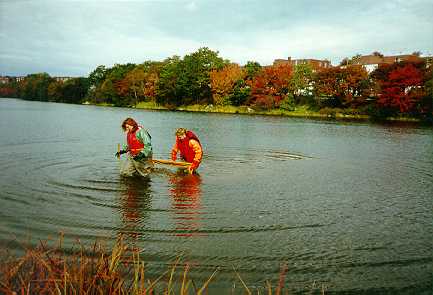
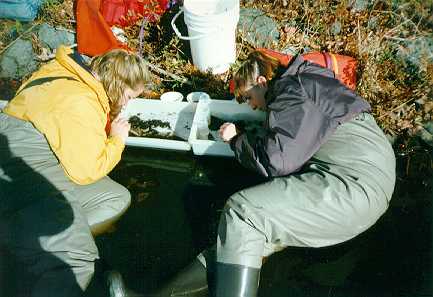
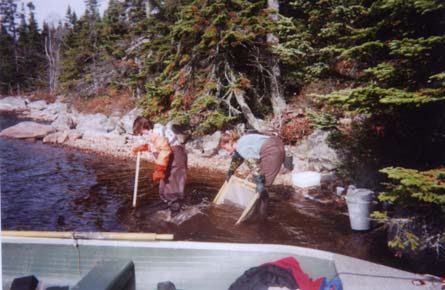
- Kim Hynes and Cathy Reeves collecting benthic macroinvertebrates at McGrath Lake using a kick-and-sweep method and a poled seine net.
- CWO. Robert MacDonald, another one of our long term volunteers assisted biologists, Kim Hynes and Cathy Reeves at Springfield Lake,.
- A local resident, Colleen Fisher
helped organize our public demonstration on a Saturday at Springfield
Lake during the National Science & Technology Week (October, 1997).
- Kim Hynes at Site-5, Morris lake on Nov 21, 1997.
- Kim Hynes and one of our partners, Phil from CFB Shearwater at Site-4, Morris lake on Nov 21, 1997.
![[Img-macroinvertebrates]](ZOOBENTH/macromin.jpg) Project E
was essentially carried out during the period, August 1998 to May 1999,
and employed two professionals and an assistant at different times. The
project was funded mostly by the Federal Government. Principal collaborators/partners in this project were, the National Research Council of Canada Institute for Marine Biosciences, Halifax through the total co-operation of its Director, John van der Meer PhD, and its Senior Research Officers, Stewart Johnson PhD, and Carolyn J. Bird PhD); and the Biological Engineering Department, DalTech through the co-operation of one of our members, Prof. Jack Burney PhD, PEng.
Project E
was essentially carried out during the period, August 1998 to May 1999,
and employed two professionals and an assistant at different times. The
project was funded mostly by the Federal Government. Principal collaborators/partners in this project were, the National Research Council of Canada Institute for Marine Biosciences, Halifax through the total co-operation of its Director, John van der Meer PhD, and its Senior Research Officers, Stewart Johnson PhD, and Carolyn J. Bird PhD); and the Biological Engineering Department, DalTech through the co-operation of one of our members, Prof. Jack Burney PhD, PEng.
Volunteer stakeholders who assisted directly were LCdr. Tom Willdey of Halifax, Prof. Jack Burney PhD PEng of TUNS, Prof. Spencer Lee PhD of Dalhousie Microbiology Dept., Prof. John Grant PhD of Dalhousie Oceanography Dept., Peter Shacklock of Portuguese Cove, P.C. MacCaull of Cole Harbour, Leonard Lowe of Fall River, David Kerr of Windsor Junction, Peter Lenaghan of Hubley Mill Lake, and Shalom Mandaville (Professional Lake Manage.) of Dartmouth.
The projects were as follows:
- {Project E-1}- This was a Primer developed by volunteer Co-Ordinator, Shalom M. Mandaville Professional Lake Manage.
Project E-1 was not part of the HRC funded project. As a total
volunteer, Shalom carried out literature survey, consulted some leading
freshwater benthic ecologists, and produced the following report, [Project E-1]. This Report will be updated with further literature a few years down the road.
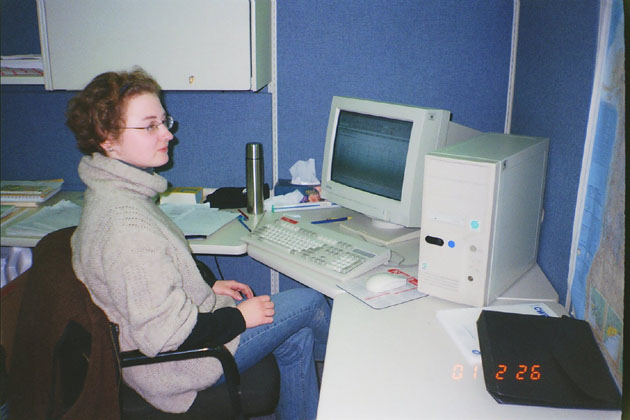
- {Project E-2}- Duration: Aug. 1998 to March 1999. Team leader was Monica Gaertner, a research biologist and a 1998 BSc(Hons) graduate from the University of Guelph,
Ontario. The second biologist, during Aug.1998 to Jan. 1999 worked
under her. Monica had taken a course titled "Biology of Polluted
Waters" from the now retired Prof. F.W.H. (Bill) Beamish PhD, a
research biologist, and another course titled, "Introduction to Aquatic
Environments" from a leading benthic ccologist/malacologist, Prof. Gerald L. Mackie PhD. Two leading Benthic Ecologists assisted in the project through the volunteer supervisor, Shalom Mandaville (Professional Lake Manage.), and they were Robert Bode, Senior Scientist with the NY State Dept. of Environmental Conservation, and Keith Somers PhD, Biostatistician with the Dorset Research Centre, Ontario Ministry of the Environment. An introductory educational video also accrued from this project and it was edited by volunteer Research Biologist, Peter Shacklock. The following report ensued, [Project E-2].
Select snapshots of Project E-2:
- Monica Gaertner and an assistant demonstrating the kick and sweep methodology at the practice lake, Maynard Lake, Dartmouth on Oct. 07, 1998.
- Monica and the assistant explaining the field work to two young onlookers at Maynard Lake on Oct. 07, 1998.
- Volunteer, Pat MacCaull at Russell lake, Oct. 22, 1998.
- Monica in the boat with volunteer, Pat MacCaull at the boat launching site, Russell lake, Oct. 22, 1998.
- Monica and the assistant picking the sublittoral zone macroinvertebrates at Russell Lake, Site 2, Oct. 23, 1998.
- Monica in "deep water" (in more ways than one!) taking in-situ readings with a Corning Checkmate Multimeter at Site 5, Russell Lake, Dartmouth on Oct. 27, 1998.
- Long-time volunteer, LCdr. Tom Willdey BSc along with the assistant picking through a sublittoral macroinvertebrate sample at Papermill Lake, Site 3, Nov. 04, 1998.
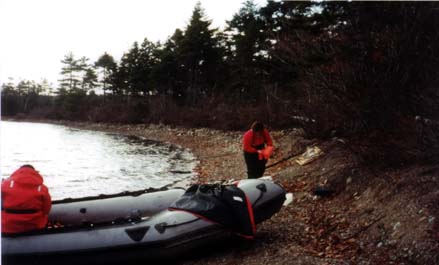
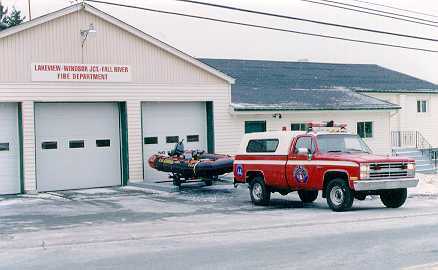
- The superb zodiac of the Lakeview- Windsor Junction- Fall River Fire Department used by us.
- Monica and volunteer, Fire Captain Leonard Lowe discussing the location of Site 2, Kinsac Lake, Nov. 09, 1998.
- Volunteer fire fighter, David Kerr viewing the sublittoral zone benthic macroinvertebrate sample at Site 5, Kinsac Lake, Nov. 10, 1998.
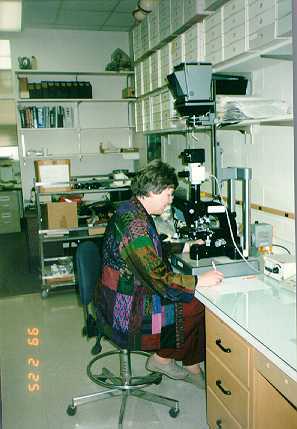
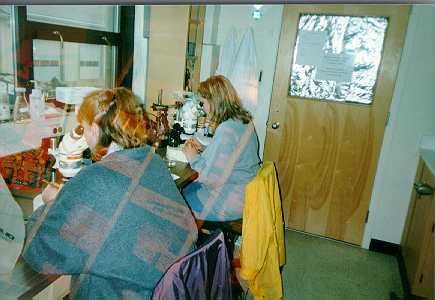
- Monica and assistant
identifying the macroinvertebrates with dissecting microscopes at the
Lab of one of our major benefactors, the National Research Council of
Canada during December, 1998.
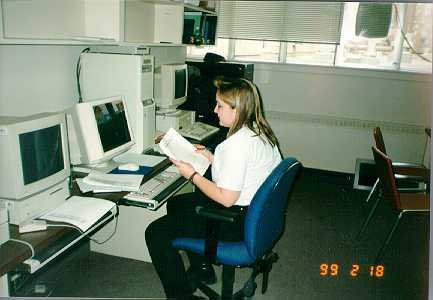
- Monica using a computer at the facilities of one of our esteemed benefactors, National Research Council of Canada Institute for Marine Biosciences, Halifax, Jan.-March, 1999.
- Monica showing a collection of the macroinvertebrates to one of our supporters, Ms. Wendy Lill, the Honourable Member of Parliament for Dartmouth.
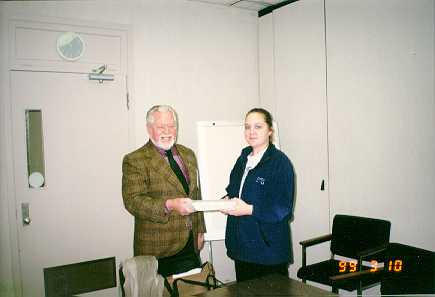
- Monica receiving an appreciation gift from a representative of our group, CWO Robert MacDonald. Bob is a veteran of WWII having served on the famous corvettes, the pride of Canada!
- {Project E-3}- Duration: March-May 1999 (8 weeks). Penelope E. Kirsch MSc was the research biologist on this Project. Ms. Kirsch graduated with an MSc in Biology from Dalhousie University
in 1997. She was the lead author of two recent papers in peer reviewed
journals; the first on Atlantic Cod published in the Canadian Journal
of Fisheries and Aquatic Sciences (1998), and the second dealing with
Harp Seals has been accepted by the journal, Physiological Zoology. The
report ensued was [Project E-3].
![[Img-smallworld]](VIEW/ICON/smallworld.gif) Project G
was essentially carried out during the first quarter of 2001 by a
brilliant International Environmental Engineering student from
Darmstadt, Germany, Ms. Heike Pfletschinger.
She was a visiting student at Dalhousie University, Department of
Biological Engineering, Halifax from the Department of Civil
Engineering, University of Applied Sciences, Bremen, Germany.
Project G
was essentially carried out during the first quarter of 2001 by a
brilliant International Environmental Engineering student from
Darmstadt, Germany, Ms. Heike Pfletschinger.
She was a visiting student at Dalhousie University, Department of
Biological Engineering, Halifax from the Department of Civil
Engineering, University of Applied Sciences, Bremen, Germany.
She worked with us for
obtaining practical, unpaid, experience and her work was exemplary, to
say the least! She was brilliant in the use of AutoCad full version and
the ArcView GIS software.
She conducted two overall projects for us:
- The first extensive project was the
Predictive Phosphorus Modelling of inland freshwater lakes in four (4)
watersheds. She completed an enormous number of lakes and ponds over 1
hectare in size totaling two hundred and seventy one (271). After some
minor sprucing-up of the models in MS Excel format and some
introductory comments by us, her work will be published.
- For this project, Heike worked from the GIS facilities of
the Halifax Regional Municipality (HRM). These superb facilities were
arranged for us by Tony Blouin PhD, Manager, Environmental Policy, Halifax Regional Municipality (HRM). The GIS staff
assisted her as needed. This project entailed extracting topographical
data, land use patterns inclusive of crown lands vested in her Majesty
the Queen in the Right of the Province of Nova Scotia, and other
relevant land use data. The data were principally extracted from the
superb GIS facilities of the HRM.
- The Predictive Phosphorus Modelling utilized the peer
reviewed and acclaimed models developed by Prof. Peter J. Dillon PhD,
formerly of the Ontario Ministry of the Environment, in order to
predict phosphorus enrichment of our lakes based on `future land use
patterns’ as well as establish the `natural pre-development background
value’ applying locally developed P-export coefficients. The phosphorus
(TP, total phosphorus) values were plotted on the world-class Vollenweider (1976) model of the OECD, Organisation for Economic Co-Operation and Development. Heike utilized the Spiral Software EasyPlot for the development of the graphical models, then inserted them into the MS Excel workbooks.
- Further, she had to conduct investigations at the Nova
Scotia Dept. of Agriculture and at the Service Nova Scotia and
Municipal Affairs for land use related data.
- c) The advantage of this methodology is to hopefully
prevent undue cultural eutrophication of our valuable
ultra-oligotrophic and oligotrophic lakes. The undisturbed lakes within
our municipality are treasured for their almost pristine status and
have been the subject of scientific admiration in some of the
international limnology community.
- A second shorter project she carried out for us was a
synoptic report on onsite sewage disposal system research conducted by
the Centre for Water Resources Studies (CWRS) at Dalhousie University,
Halifax.
We salute the Chebucto Community Net (CCN) of Halifax, Nova Scotia, Canada for hosting our web site, and we applaud its volunteers for their devotion in making `CCN' the best community net in the world